
Coming in MultiPortal 1.3: alerts for service providers, resellers and tenants
A first look at Notifications and Alerting in MultiPortal 1.3, with configurable conditions, incident management and notification channels for service providers, resellers and tenants.
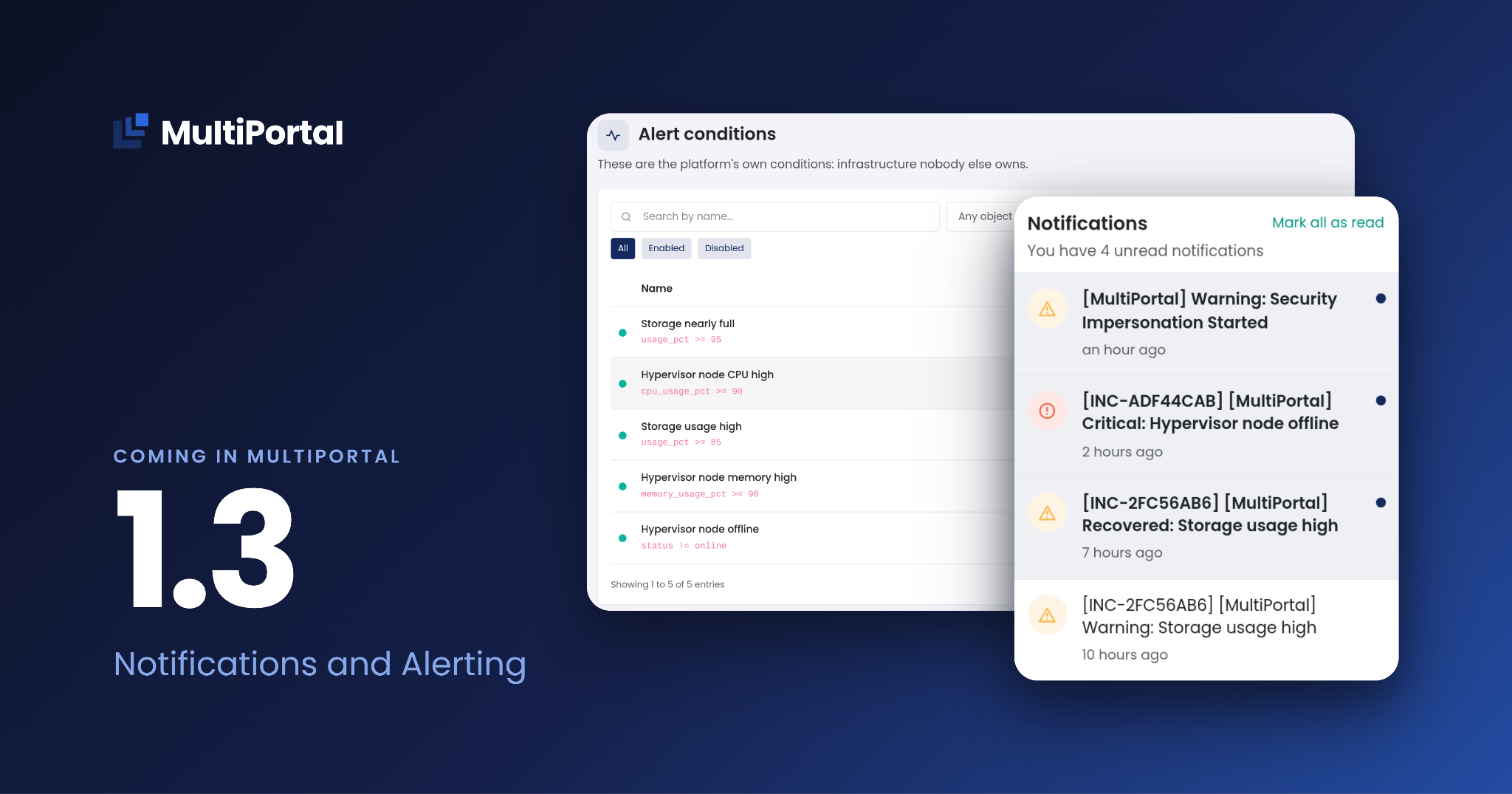
New to the series? This is the second article in our MultiPortal 1.3 series. The introduction covers the five key features planned for the release.
Across multiple resellers and tenants, node status, storage capacity and tenant resource usage all need attention, and a problem that develops between manual checks can go unnoticed until a customer reports it.
MultiPortal 1.3 introduces Notifications and Alerting. You choose which conditions raise an incident, who is notified and how. Your resellers and their tenants manage alerts for their own environments, and you keep visibility across the companies you manage.
Storage filling up, a node down, a tenant near quota: what do you want to hear about?
Alert conditions cover the state and capacity of your VMs, nodes, storage and tenant quotas. You set a severity for each one, and choose whether it raises an incident immediately or only after it stays breached for a set number of collections. MultiPortal shows the worst-case detection time before you save.
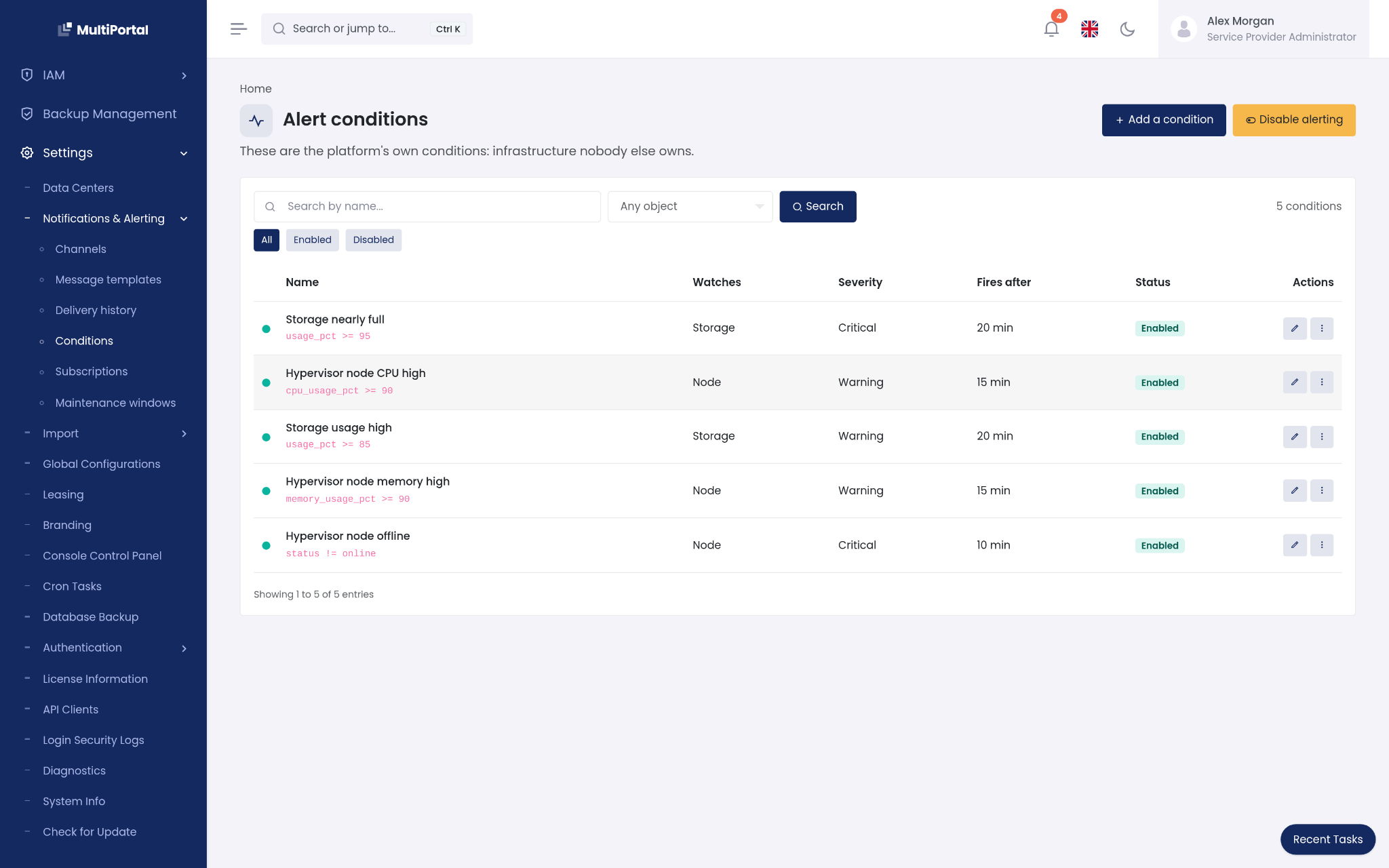
Each tier has its own scope for conditions. Service providers can set conditions over infrastructure and all the resources they own. Resellers can set conditions for the assets they own, and tenants for their own VMs and quotas.
How soon will you know something is wrong?
Alerting uses data MultiPortal already collects from your Proxmox clusters, so it adds no load to them. Detection follows the existing collection interval. A condition that starts and clears between two collections may not be detected, and one that stays breached raises an incident according to the rule you set.
The first check of a condition records its state without raising an incident, so enabling alerting does not trigger alerts for existing conditions. After that, a condition that meets its breach requirements raises an incident, which resolves automatically when the condition clears. Repeat breaches are suppressed as duplicates, so a fluctuating condition does not repeat the same incident.
One problem, three audiences: who hears what?
Your reseller and tenant structure sets who sees what. You see incidents from your own environment and the companies beneath you, resellers see their own and their tenants’, and tenants see their own environments. Infrastructure alerts stay with you as the service provider.
Each company chooses which incidents notify it, by severity, object type or specific conditions, and sends them to recipients and channels within that company’s scope.
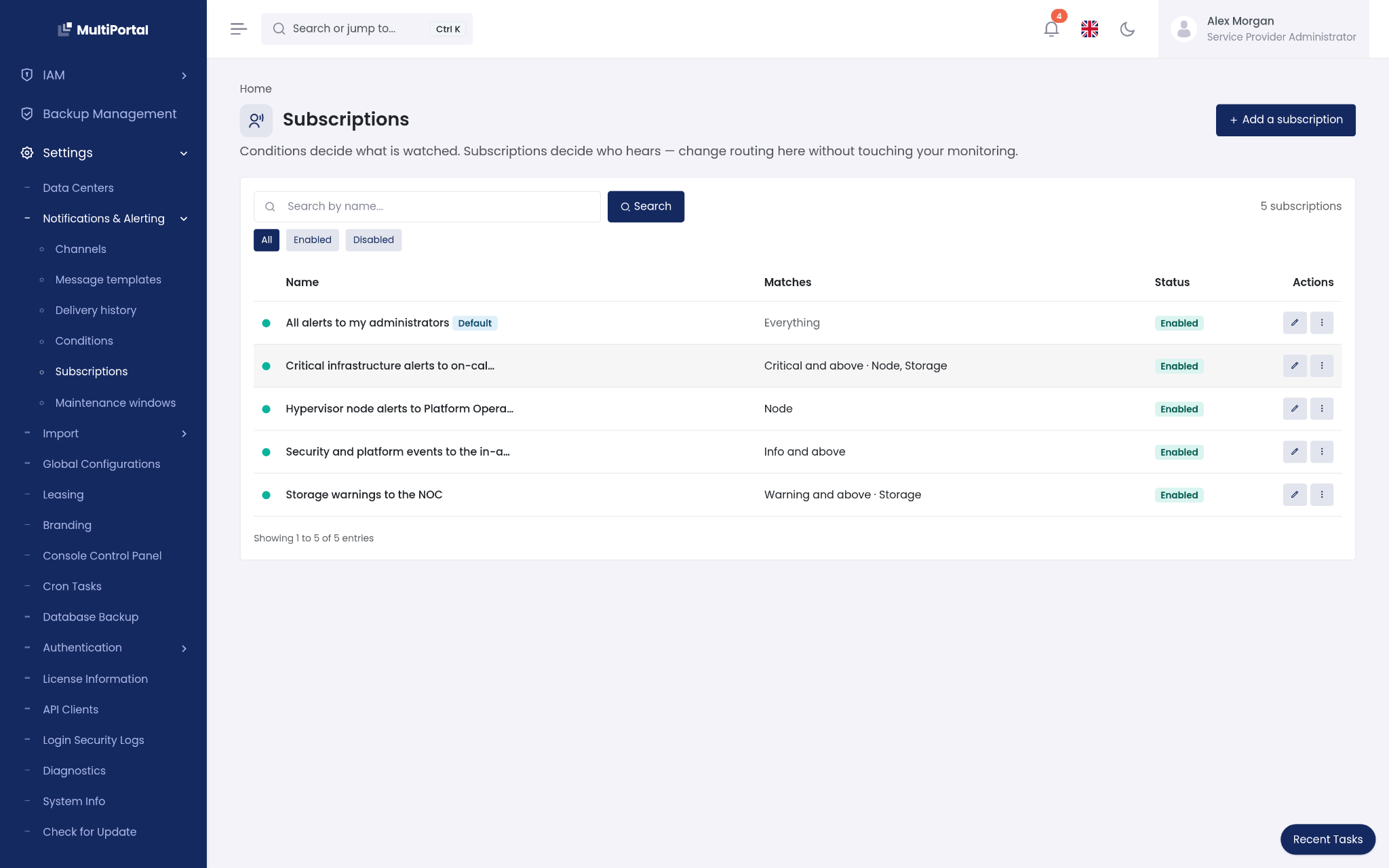
You can also make notification channels available to your resellers and tenants. Resellers can use a channel you provide or configure their own, and tenants can use one from their reseller or connect their own. Notifications go out through the communication services you or your reseller have configured.
Email, Slack or PagerDuty: where should the alert go?
MultiPortal 1.3 supports 13 notification channels: email, the in-app inbox, Slack, Microsoft Teams, Telegram, Matrix, Mattermost, Discord, Rocket.Chat, PagerDuty, ntfy, Gotify and webhooks.
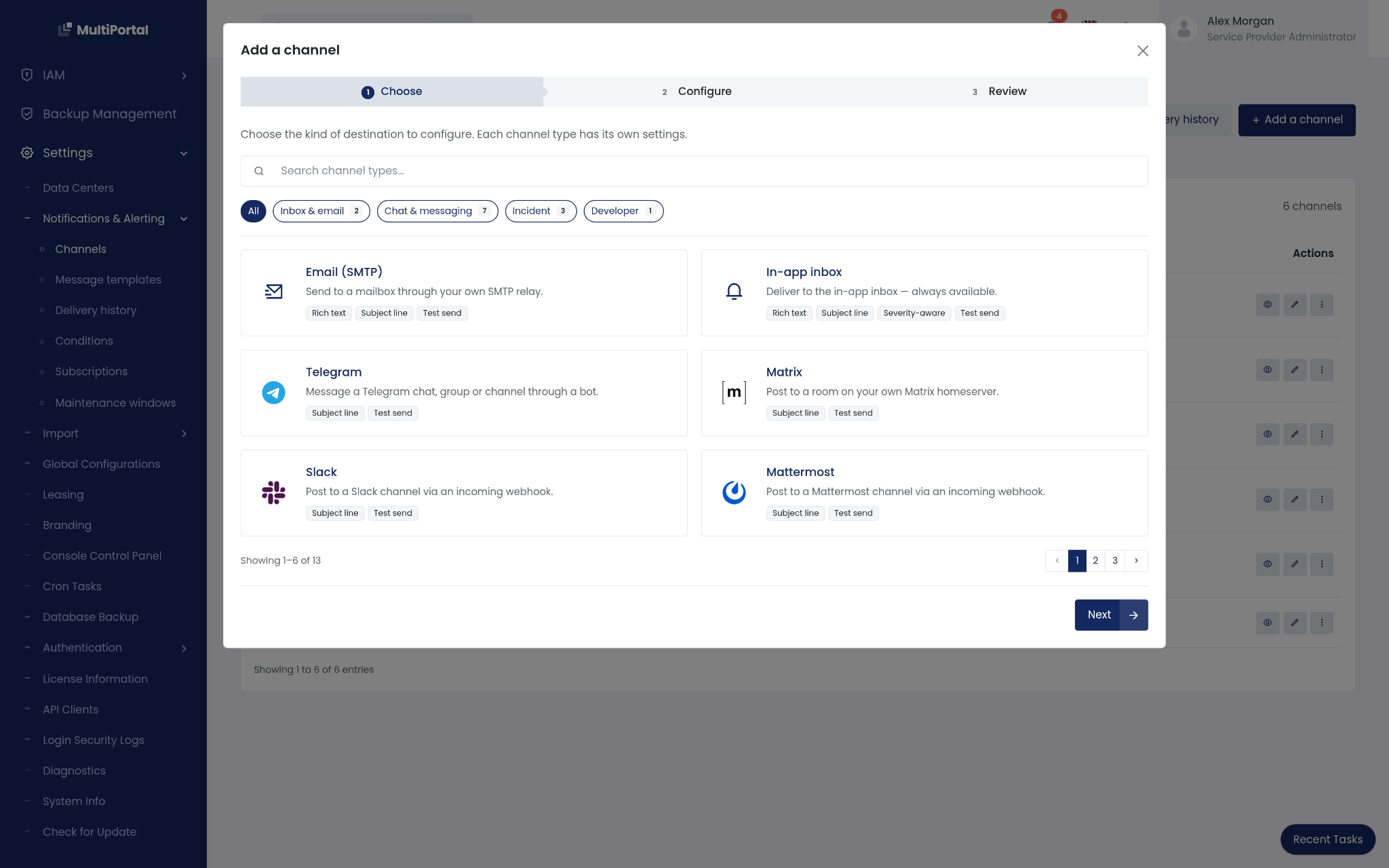
Webhooks connect notifications to other systems that accept them. Channels such as email, Slack and webhooks include a test send, so you can confirm your configuration works before an incident depends on it.
The alert has fired: what happens next?
Your team can acknowledge or mute an incident from its timeline. During planned work, a maintenance window suppresses your own notifications. The incident is still raised and visible, and your resellers and tenants keep receiving theirs.
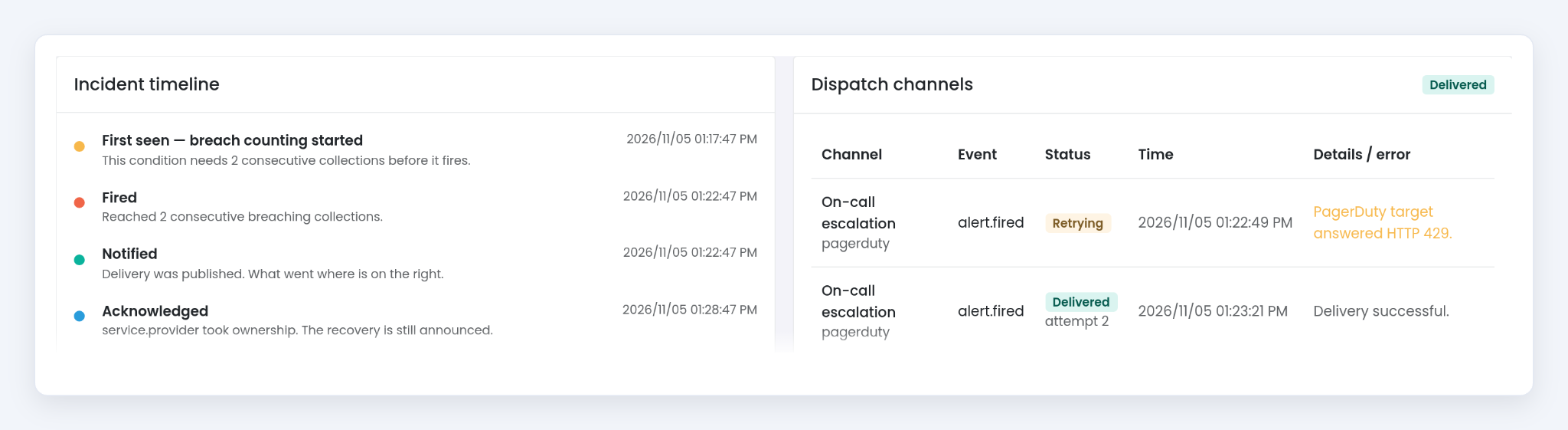
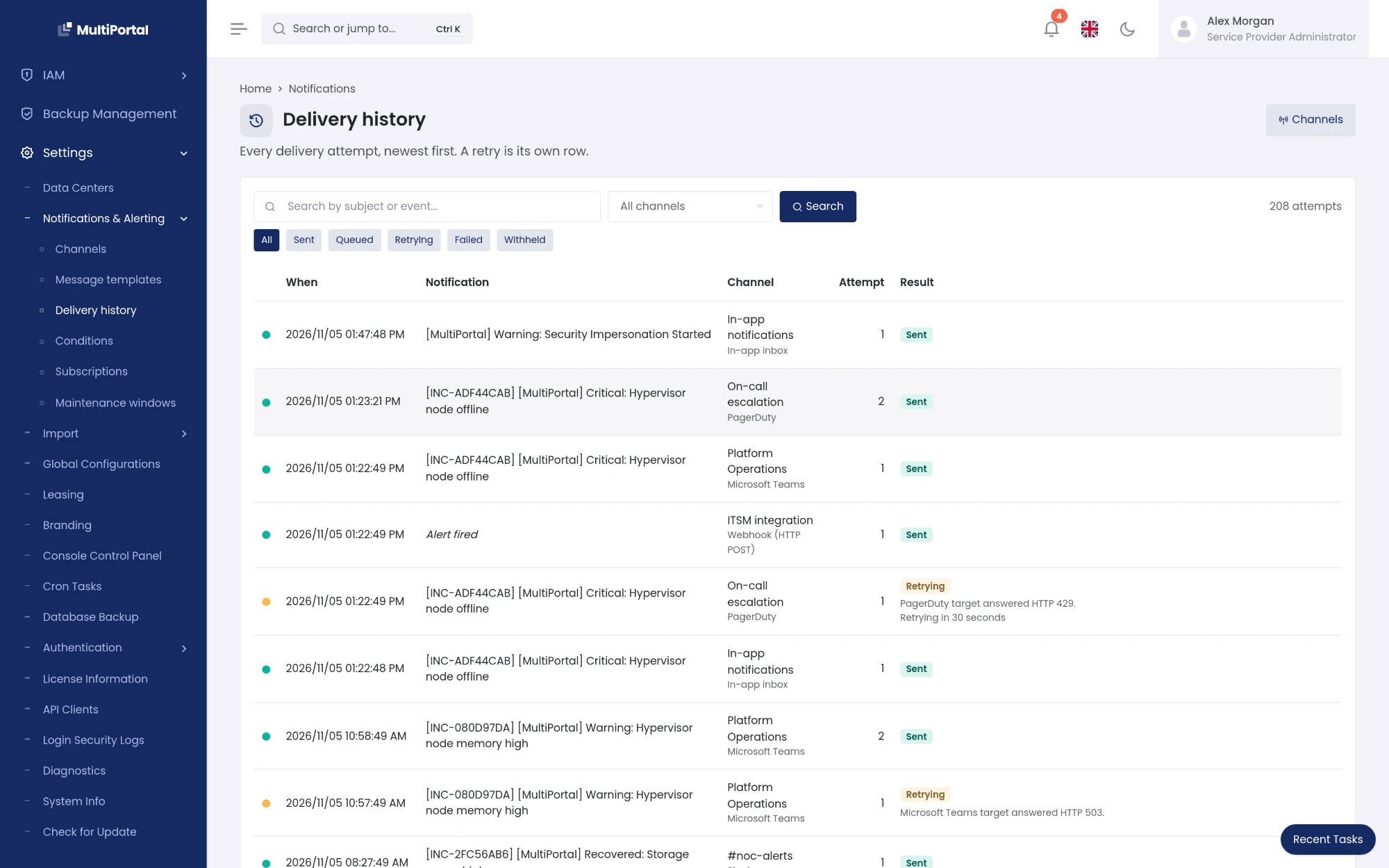
The timeline shows who was notified and through which channel, and delivery history records each send attempt.
Stay tuned for the next post in this series: IPAM in MultiPortal 1.3. Just as VMs, nodes, storage and tenant quotas have capacity limits, so do IP address ranges. IPAM gives service providers a clearer view of how IP addresses are assigned across resellers and tenants, how many are in use, and how much capacity remains.