
MultiPortal for service providers: multi-tenant management for Proxmox after Cloud Director
Proxmox replaces VMware ESXi, but not VMware Cloud Director. Here is how MultiPortal gives service providers tenant isolation, self-service, metering, white-label and delegated administration on Proxmox.
If you’re a service provider that has left VMware, is leaving now, or already runs Proxmox, you still have a problem to solve. Proxmox replaces VMware ESXi, the software that runs your virtual machines. It does not replace VMware Cloud Director, the tool many providers use to give customers self-service and to bill them accurately.
That gap has become urgent since Broadcom closed the VMware provider programme. VCSP contracts were not renewed after 26 January 2026, and the programme became invite-only. Thousands of providers had been in it, and many European CSPs lost partner status. The Cloud Director product line has reached the end of availability, with no new subscriptions and no renewals.
Who is in this position
For most of these providers, the open question is what to run above the hypervisor.
The five things Cloud Director handled
- Tenant isolation: each customer’s environment stays separate from every other customer’s.
- Self-service provisioning: customers create what they need without waiting on you.
- Quotas and metering: limits are enforced and usage is recorded. Metering you can’t trust means under-billing.
- White-label: the platform shows your brand. Without it, you’re building someone else’s brand, and customers and competitors can see what runs behind it.
- Delegated administration: resellers and customers manage their own accounts, so your team doesn’t handle every change.
None of these comes with Proxmox, and most providers fill the gap with in-house scripts.
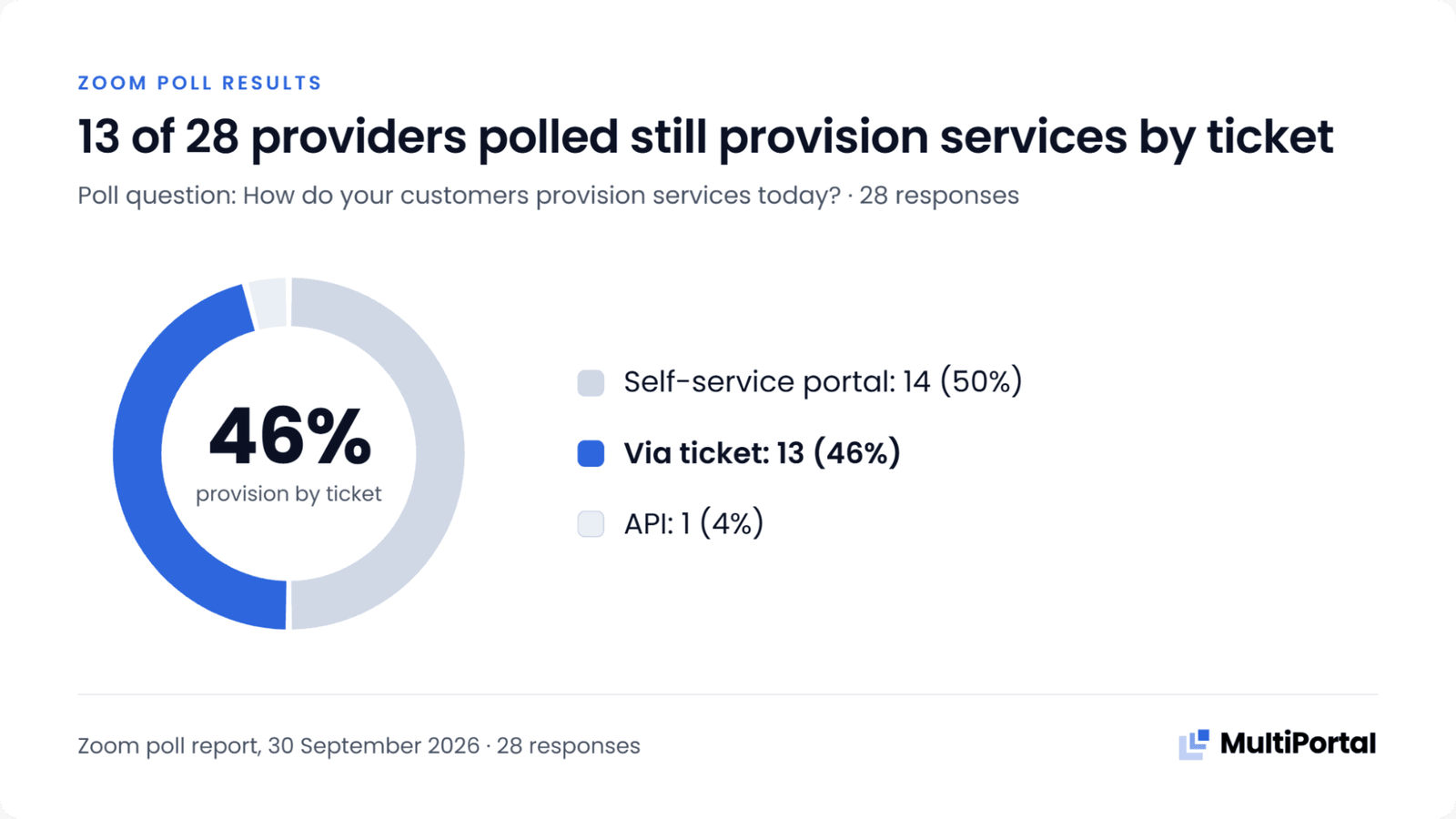
Ticket-driven provisioning limits how many tenants one engineer can carry, so growth means hiring more engineers.
Meet MultiPortal
MultiPortal is a multi-tenant management layer built for Proxmox. It sits above the hypervisor and covers the five areas above. It started as an internal tool at a cloud hosting provider, built to fix the multi-tenancy problems the team kept running into.
| What Cloud Director handled | What MultiPortal provides |
|---|---|
| Tenant isolation | Complete isolation per tenant, with resources allocated through Virtual Data Centres. |
| Self-service provisioning | Tenants create and manage VMs, open a browser console, take snapshots and restore single files themselves, with a REST API covering everything in the UI. |
| Quotas and metering | Allocation or consumption quotas, reseller quotas, and usage metrics ready for billing. |
| White-label | Your own branding and domain at every level, set by each parent for the level below. |
| Delegated administration | A multi-tier reseller hierarchy with role-based access control. |
How the levels work
MultiPortal organises your business in four levels:
- Service provider: full platform control, with your own brand and domain.
- Reseller: its own branding, domain and delegated administration. A reseller owns tenant onboarding, quota allocation from its own pool, first-line support and its own pricing.
- Tenant: a customer with complete isolation, its own branding and its own domain.
- Virtual Data Centre: the resource envelope, either a fixed quota or pay-as-you-go.
Branding cascades down and each parent decides how much the level below can override. Identity options include LDAP, SAML and OAuth with just-in-time provisioning, and 2FA.
One customer request, end to end
A single VM request moves through three views with no ticket raised.
- Service provider: you create a reseller and set its allocation, storage tiers and network.
- Reseller: under a different brand and domain, the reseller creates a tenant and a Virtual Data Centre.
- Tenant: the customer deploys a VM, opens its console, takes a snapshot, restores a single file and applies a firewall rule.
- Back at the provider level: usage is ready to bill and the audit log shows who did what.
Cost and control
Licensing is per socket, regardless of core count. Community is free for up to four sockets, Standard is €23.09 per socket per month, and Premium is €37.62 per socket per month (1-year prepaid term at 25 sockets, so rates vary).
CL Hosting, a French cloud service provider that runs its Infrastructure as a Service offering on MultiPortal, reported a 36% cost reduction after moving off VMware. Livewire Cloud reported 45% lower total cost of ownership.
MultiPortal runs in your own infrastructure with no vendor control plane, and the only outbound call is licence validation.
How to try it
- Live demo environment: log in as the provider, the reseller and the tenant, with no call needed. It takes about five minutes.
- Community edition: free, with no time limit.
- 30-day trial: every feature on the paid plans, no card needed.